
About the Practice

Latitude 26 was built on a straightforward conviction. The medicine most people still remember, a provider who knew you and had time for you and answered to you, was never obsolete. It was priced out of the system that replaced it.

Your Provider

The practice is deliberately small. You will know your provider, and your provider will know you.

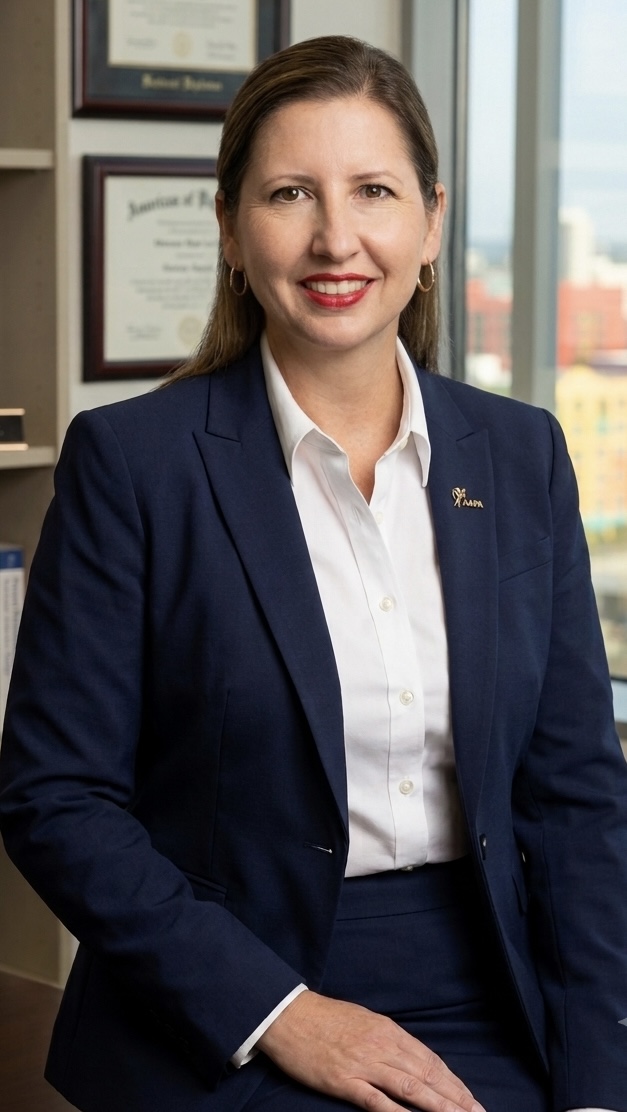
Colleen B. Coburn, PA-C, founding provider of Latitude 26 Concierge Medical

Colleen B. Coburn, PA-C

Founding Provider

Colleen Coburn brings over 30 years of combined military and clinical healthcare experience, and has been licensed as a physician assistant since 2014. That work spans Coast Guard clinics, pediatric trauma bays, and operating rooms across South Florida.

She began in 1995 as a U.S. Coast Guard Health Services Technician, rising to Clinic Supervisor before earning her Master of Science in Physician Assistant Sciences through the University of Nebraska's Interservice Physician Assistant Program. As a commissioned officer she served as Senior Medical Officer at USCG Base Miami Beach, the primary care provider for more than 1,500 active-duty and reserve personnel, responsible for everything from routine medicine and minor surgery to emergency stabilization, behavioral health, and substance-use evaluation. In 2019 she was one of only two candidates nationwide interviewed for Tactical Medical Officer with the White House Medical Unit. She retired in 2020 as a Lieutenant, after 25 years of military service.

Her surgical career has run alongside it. At Nicklaus Children's Hospital she served as a Pediatric Surgery Physician Assistant, stabilizing arriving trauma patients and first-assisting in the operating room. At the Paley Orthopedic & Spine Institute she was the lead orthopedic trauma provider at St. Mary's Medical Center. She continues to operate as a surgical first assistant at hospitals throughout Broward County, across nine specialties: orthopedic, trauma, general, plastic, breast oncology, neurosurgery, ENT, gynecologic, and laparoscopic.

That range is unusual, and it is the point. Colleen has managed a patient's chronic conditions in clinic, stabilized them in an emergency, and stood across the operating table from them. Very few primary care providers have seen the whole arc, and it is what allows her to tell you, plainly, what a proposed procedure actually involves and whether you need it.

She is board-certified by the NCCPA and licensed in Florida with full prescribing authority. She lives in Hollywood with her husband and children.

As required by Florida law for physician assistants, your provider practices in collaboration with a licensed supervising physician and maintains a formal Supervisory Protocol. This arrangement is administrative: the supervising physician does not see patients, is never a point of contact, and has no role in the practice's business or day-to-day decisions. You see your provider directly for all of your care, and your provider runs the practice. The protocol provides for chart review and physician consultation as the law requires, and places no one between you and your provider.

Practice philosophy

Three convictions shape how this practice works.

Time is a clinical instrument, not a courtesy.

Most diagnostic misses are not failures of knowledge. They are failures of attention: the symptom not mentioned because there was no room to mention it, the follow-up question never asked, the pattern invisible because nobody had time to look for it. Ninety minutes is not hospitality. It is how the medicine gets done properly.

Continuity compounds.

A provider who has known you for six years is working with something no first visit can supply: the shape of your normal. Knowing what is unremarkable for you is what makes a change visible while it is still small. That knowledge accumulates, and it cannot be transferred, delegated, or reconstructed from a chart.

The relationship should answer to you and to no one else.

When a practice bills insurance, a third party with its own interests sits inside every clinical decision. When members pay the practice directly, that seat is empty. There is no incentive to see more people, order more tests, or schedule a follow-up your care does not require. The practice works for you, not an insurance company. You are the person we answer to, and the only one we serve.

Founding story

We live in a hectic world with high demands on our time. More often than not, the thing that gets pushed to the bottom of the list is our own health.

Medicine used to be about treating and nurturing patients, about optimizing someone's health and well-being over the long run. Somewhere along the way, that got lost in automated phone trees, fifteen-minute appointment slots, insurance red tape, and the shareholder bottom line.

When I was active duty in the military, I didn't realize how fortunate I was. There was no minimum number of patients I had to see in a day. I was paid the same whether I saw twenty patients or three. I had, essentially, as much time as I needed to address every one of my patients' concerns. So I gave people the time and attention they deserved, and they felt it. They felt seen. They felt cared for. And my clinical outcomes reflected it.

When I retired from the military, I discovered how difficult that kind of care is to find on the outside. I struggle to get it myself. And I'm a medical provider. If someone who knows this system from the inside has to fight for it, imagine what it takes for everyone standing outside of it.

I am now at a point in my career where I can build the practice I would want for my own family: one where you are never rushed, never a number, and never left to figure it out alone. That is exactly what Latitude 26 is.

Colleen B. Coburn, PA-C Founding Provider

Membership limited to 100 patients per provider.

Request an Invitation